
Plaque and Calculus
Did you know that plaque is the main cause of gum disease?
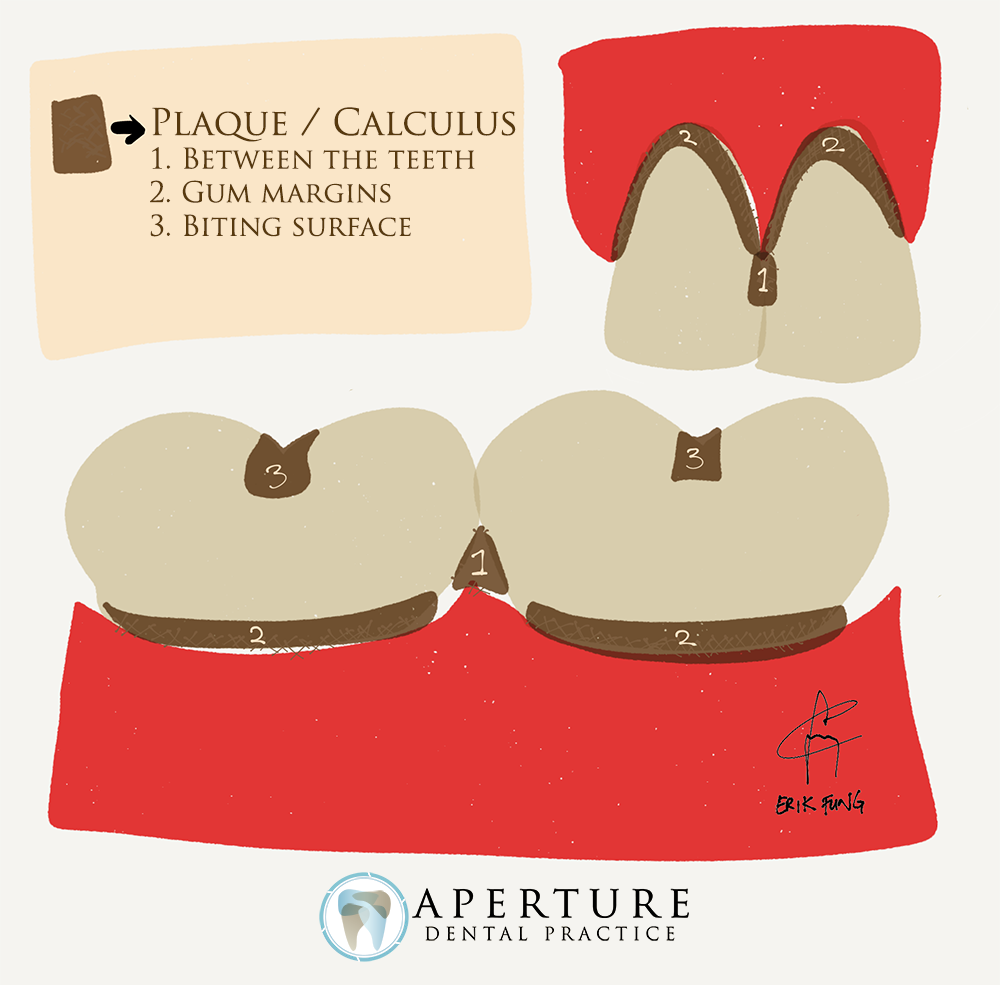
It typically accumulates in between the teeth, along the gum margins, and on the biting surfaces of the teeth.
What is plaque?
Plaque is the soft, white, yellowy substance that accumulates at the margins of the gums and the teeth. It becomes more evident after a meal, or at the end to the day.
Plaque contains bacteria which causes an inflammatory reaction in the gums, which leads to gingivitis.
If the plaque is removed, the gingivitis goes away. Otherwise, the gingivitis can progress to periodontitis. Periodontitis is inflammation that affects not just the gums, but other areas supporting the tooth. such as the bone.
What is calculus?
Calculus (also known as “tartar”) is plaque that has calcified and hardened.
If you allow the plaque to stagnate for too long without removing it, it calcifies to form a hard, lumpy layer, which cannot be removed with the toothbrush.
Typically, calculus along the gum lines forms in two places:
- Tongue side of the lower front teeth
- Cheek side of the upper back teeth
This is because there are salivary ducts close to those areas, and the calcium in the saliva hardens the plaque.
The problem is, once calculus forms, it has the potential to continue accumulating and forming more deposits.
Some people have had it for so long that they think it is part of their natural teeth!
Some habits make people more predisposed to formation of calculus, e.g. smoking.
Visiting the dentist to have scaling done is the only sure way to remove calculus.
So, clean your teeth thoroughly every day to avoid plaque hardening to form calculus!
Dental Decay
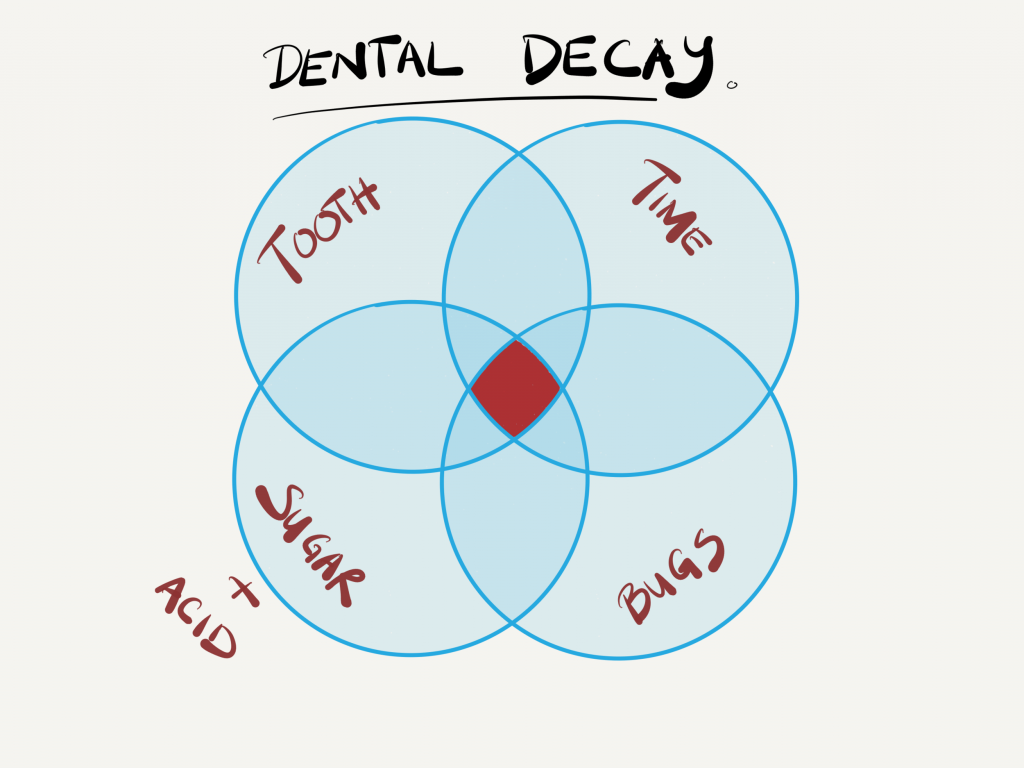 Tooth decay is the most common chronic disease in Australia. 25% of adults have untreated tooth decay.
With today’s sugary foods becoming cheaper and more accessible, it is not surprising that this problem will always be prevalent.
However, the good news is that tooth decay is totally preventable and, in some cases, reversible!
Whenever our teeth get a sugar attack by eating sugary foods, the bacteria in our mouths converts it to various acids which erode the teeth. This is the beginning of tooth decay. Studies have shown that it takes 30 minutes to an hour to recover from a 1-minute sugar attack!
This information tells us that if we don’t give our teeth enough time to recover, the acids will continuously erode the teeth until holes start to form.
Many carbonated drinks will affect the teeth in a similar way. Not only because they contain a lot of sugar, but also because the fizz is acidic and can cause erosion of the teeth. So that’s double trouble!
Another thing to bear in mind is FLUORIDE can help strengthen our teeth and prevent decay further. So, use a fluoride toothpaste regularly!
Tooth decay is the most common chronic disease in Australia. 25% of adults have untreated tooth decay.
With today’s sugary foods becoming cheaper and more accessible, it is not surprising that this problem will always be prevalent.
However, the good news is that tooth decay is totally preventable and, in some cases, reversible!
Whenever our teeth get a sugar attack by eating sugary foods, the bacteria in our mouths converts it to various acids which erode the teeth. This is the beginning of tooth decay. Studies have shown that it takes 30 minutes to an hour to recover from a 1-minute sugar attack!
This information tells us that if we don’t give our teeth enough time to recover, the acids will continuously erode the teeth until holes start to form.
Many carbonated drinks will affect the teeth in a similar way. Not only because they contain a lot of sugar, but also because the fizz is acidic and can cause erosion of the teeth. So that’s double trouble!
Another thing to bear in mind is FLUORIDE can help strengthen our teeth and prevent decay further. So, use a fluoride toothpaste regularly!

- Avoid sugary foods as much as you can.
- Sugary foods should only be taken during main meal times.
- Avoid snacking on them between meals.
- Use a straw when drinking sweet or fizzy drinks.
- Swallow sweet drinks without slushing it around in your mouth!
- Don’t eat anything after you brush your teeth at night. Go to bed!
Gum Disease
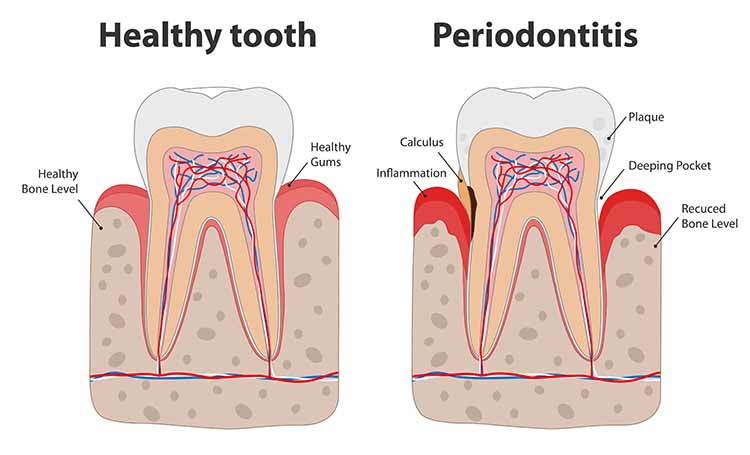 Alongside dental decay, the next most common oral disease is gum disease. Gum disease (or periodontal disease) is characterised by:
- Bleeding gums
- Accumulation of plaque and calculus (tartar)
- Receding gums
- Loose teeth
- Drifting teeth
- Bad breath
- Gum detachment
- Swelling of the gums
- Loss of teeth!
- Pain!
- Brush your teeth twice a day with a soft bristle toothbrush
- Plaque accumulates at the gum margins – do not neglect cleaning the area where the teeth meet the gums
- Calculus (tartar) usually accumulates on the tongue side of the lower front teeth and the cheek side of the upper back teeth – give those areas extra attention!
- Floss to clean the areas between the teeth where the toothbrush can’t reach
- Flossing and mouthwash, together with toothbrushing, increases plaque removal by about 20%
- Electric toothbrushes can be more effective at cleaning our teeth
Oral Cancer
 Oral cancer constitutes about 6.5% of all cancers in Australia.
Early detection of cancer always has a better prognosis in terms of its treatment outcome.
At Aperture Dental, we always screen and check for signs of oral cancer as part of your regular check-up.
It is also important that you let us know if you have any concerns.
Oral cancer sometimes mimics an ulcer, appearing as a persistent red/white patch, or a firm swelling.
Sometimes, it is painless, and this is why people delay their examinations.
If you think you have any of the following symptoms*, get it checked out as soon as possible:
Oral cancer constitutes about 6.5% of all cancers in Australia.
Early detection of cancer always has a better prognosis in terms of its treatment outcome.
At Aperture Dental, we always screen and check for signs of oral cancer as part of your regular check-up.
It is also important that you let us know if you have any concerns.
Oral cancer sometimes mimics an ulcer, appearing as a persistent red/white patch, or a firm swelling.
Sometimes, it is painless, and this is why people delay their examinations.
If you think you have any of the following symptoms*, get it checked out as soon as possible:
- Persistent ulcers – unexplained ulcers that last for more than two weeks
- Persistent or growing lump
- Fixation of tissues
- White patches in the mouth
- Neck lumps or swellings
Smoking
It is well documented that smoking has a strong link with an increased risk of oral, throat and lung cancer. Smoking tobacco releases over 4000 chemical compounds into the mouth and air. It is no surprise that a smoker will have a 10 – 20 times higher chance of developing cancer than a non-smoker. In the mouth, the most commonly affected areas are lips, under the tongue, the tongue itself, cheeks and the palate. Speak to your GP if you need help to stop smoking. If you have any concerns about oral cancer, contact us on 07 3188 9477, and we are here to help!Fluoride
 Teeth can be more resistant to decay if fluoride is used on:
- Developing teeth – The ‘developing’ teeth can utilise fluoride from the body, i.e. by using INGESTED fluoride while the teeth are still forming. However, too much fluoride increases the risk of forming mottled teeth (fluorosis).
- Existing teeth – The enamel of the existing teeth is more resistant if there is a coated fluoride-crystal surface. This fluoride-crystal surface is formed when the tooth is exposed to fluoride ON the tooth surface.
- Fluoride Toothpaste
- Fluoride mouth rinse
- Fluoride Gels/varnishes
- Water fluoridation
- Fluoride supplements
- Fluoride in table salt
*It is important to understand that teeth that are ALREADY formed DO NOT become mottled if exposed further to fluoride…it just becomes stronger!
AND the body cannot utilise ingested Fluoride if the tooth is already formed.